

Buying wine in France with an electric car raises one question before any other: will range fear spoil your day? We put it to the test with a small Peugeot e-208, from Tower Bridge to our shop in Calais and back, on our free day-trip crossing. Range, onboard charging, chargers next to our shops and the real cost of the day: here is what we learned.
A free crossing for €300 of wine: does the maths work?
Our day-trip deal is simple. Pre-order €300 or more of wine, beer, champagne or spirits on wine-calais.co.uk and we cover a same-day return ferry crossing from Dover with P&O Ferries. Your order waits for you at Calais Vins or Olivier Vins, ready to load into the boot.
The second saving comes at the till. British visitors reclaim French VAT through Global Blue or Skiptax, which brings back 15% of the bill. On a €300 basket, that means €45 returned within a few days of boarding.
| What a €300 pre-order gives you | Detail |
| Same-day return crossing Dover to Calais | Free with P&O Ferries |
| VAT refund via Global Blue or Skiptax | Around 15%, about €45 on €300 |
| Still wine allowance per adult | 18 litres, or 24 bottles of 75 cl |
| Beer allowance per adult | 42 litres |
| Spirits over 22% abv | 4 litres, or 9 litres of sparkling and fortified wine (the allowance can be split) |
HMRC caps still wine at 18 litres per adult, the equivalent of 24 standard bottles. Our guide to UK alcohol allowances from France goes through every category in detail. Our customers rarely come for volume alone, as Jérôme Pont, co-founder of Calais Vins, put it:
"Our British clientele understands the value of purchasing wine from us. They're looking for more than just cheap booze."
The question our test set out to answer was a different one: does a battery-powered car turn that saving into a headache?
London to Dover in a Peugeot e-208: range, ULEZ and tunnel charges
We chose a small car on purpose. Peugeot quotes more than 300 km of range for the e-208, yet on the motorway our car never gave us more than 200 km on a full battery. That real figure is the one to plan around.
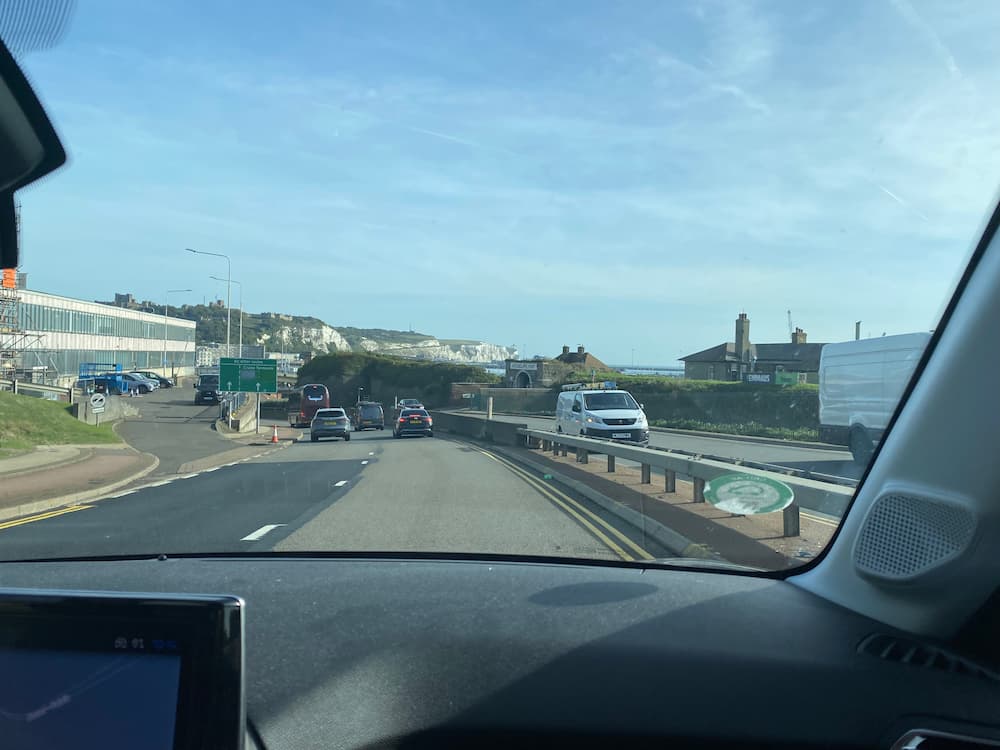
We set off from Tower Bridge, took the Limehouse Link, crossed under the Thames through the Blackwall Tunnel and joined the M2 towards Kent. The run to the port of Dover covers around 125 km. We reached the check-in lanes without a single charging stop, with 50% of battery left.
What London charges an electric car
- ULEZ: a fully electric car meets the Ultra Low Emission Zone standards and pays nothing.
- Congestion Charge: Transport for London ended the full exemption on 25 December 2025. An electric car registered for Auto Pay now pays £13.50 a day inside the central zone, instead of £18. Check whether your starting point sits inside it.
- Limehouse Link: this tunnel runs under Tower Hamlets and carries no charge.
Blackwall Tunnel: electric cars pay too
Since 7 April 2025, Transport for London charges every car using the Blackwall and Silvertown tunnels, electric or not. From 21 September 2026, a car registered for Auto Pay pays £1.55 off-peak and £4.20 at peak times. Without Auto Pay, the peak rate applies all day between 06:00 and 22:00.
Peak hours run from 06:00 to 10:00 northbound and 16:00 to 19:00 southbound on weekdays. A morning departure towards Dover and an evening return into London both fall outside those windows.
Charging on the ferry: P&O Pioneer and P&O Liberté
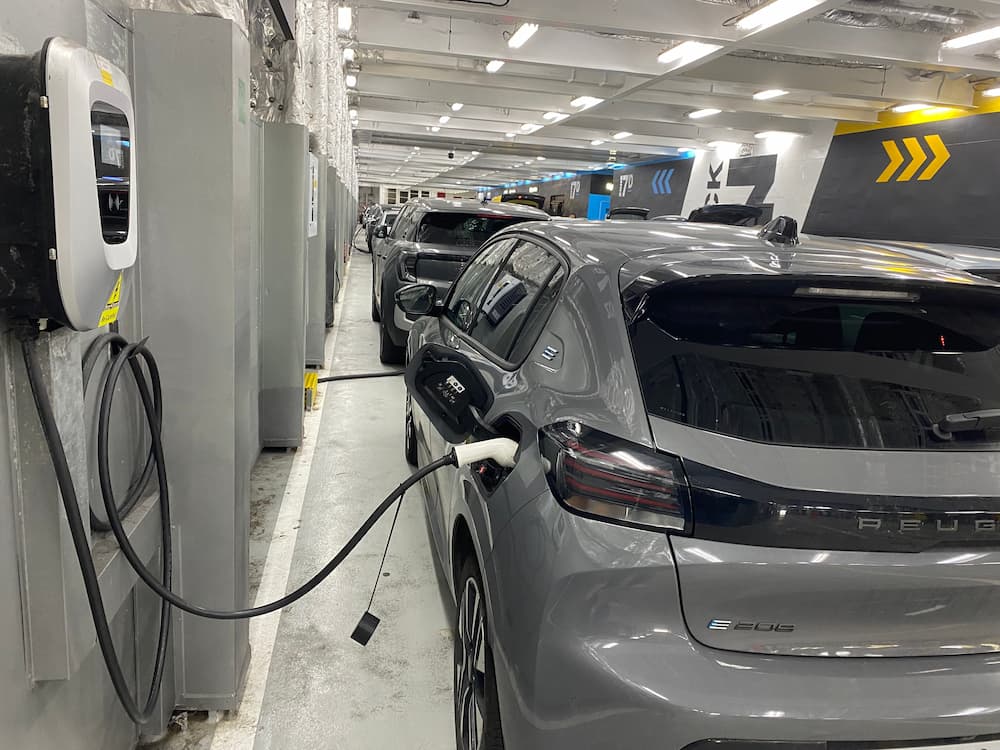
With half a battery left, the drive home was on our minds. The answer came on the car deck. P&O Ferries runs two ships with electric car charging on the Dover to Calais route: P&O Pioneer and P&O Liberté. We sailed on P&O Pioneer.
On board, £10 buys 12 kWh and £20 buys more than 20 kWh. We took the £10 option. Between boarding in Dover and driving off in Calais, close to two hours, our e-208 went from 50% to 84%.
How to charge on board
- Speak to a member of the onboard team as soon as you board and ask for a charging spot.
- Choose the £10 or the £20 option, depending on the charge you need.
- Switch the car off before leaving the deck: P&O requires every electric vehicle to stay off during the crossing.
Not every P&O ship has chargers
P&O Ferries does not guarantee a charging spot: it depends on space and operational capacity on the car deck. On our way home we sailed on Spirit of France, which has no charging points at all. Your outbound and return ships can differ, so plan the homeward leg without counting on the ferry. Also with 84% battery, we could make our way back to London.
| Ship on Dover to Calais | Onboard charging |
| P&O Pioneer | Yes, £10 to £20 |
| P&O Liberté | Yes, £10 to £20 |
| Spirit of France | No |
Travelling by LeShuttle instead? Its Folkestone and Calais terminals each have four 210 kW ENGIE chargers. Our guide to choosing your Dover to Calais crossing compares all the options.
Where to charge in Calais, next door to our shops
Range anxiety fades fast once you drive off the ferry. Chargemap lists 82 charge points in Calais, 28 of them rapid chargers.
Near Calais Vins, Rue Gutenberg
The Atlante station on the car park opposite Kiabi, at 44 Rue Gutenberg, sits on the same street as Calais Vins. It has 8 CCS charge points rated up to 300 kW, plus a 22 kW Type 2 socket, and takes bank cards, the myAtlante app and RFID cards.
Near Olivier Vins, Fréthun and Cité Europe
At Cité Europe in Coquelles, a few minutes from Olivier Vins, Allego runs 300 kW CCS chargers in the Carrefour car park, open 24 hours a day with card payment. The Tesla Supercharger station at the Eurotunnel terminal accepts other brands with a CCS plug.
Our tip: one app, one card
We downloaded Chargemap and ordered the Chargemap Pass before leaving London. One card starts a session on more than 1,800 networks in Europe, so we never had to install a new app for each operator. Keep one detail in mind: a 300 kW charger does not make a small car charge at 300 kW. The e-208 accepts up to 100 kW, so allow a little longer on the plug than the sign suggests.
The good news is that the charging time fits the visit:
- a free tasting at our bar with one of our English-speaking sommeliers;
- collecting your pre-order and adding a few extra bottles;
- lunch in town, as part of a full Calais day trip.
Weight, boot space and the drive home

Wine is heavy. A case of six 75 cl bottles weighs around 7 to 8.5 kg, so a full adult allowance of 24 bottles adds roughly 30 to 35 kg to the car. Extra load raises energy use a little, so build a margin into the return leg instead of planning to arrive home on 5%.
Wine boxes help. A 5-litre box holds almost seven bottles of wine with far less glass, and it packs flat against the back seats. Our guide to 5-litre wine boxes in Calais lists the range.
Our return plan
- Charge in Calais during the shopping and lunch stop, since a ship like Spirit of France gives nothing back during the crossing.
- Leave Calais with enough battery for the 125 km from Dover to London plus a margin. With 200 km of real range, that meant 80% or more for our e-208.
- Validate your VAT refund before boarding: scan the Global Blue form at the kiosks of the ferry terminal or the Eurotunnel passenger building, or the Skiptax barcode at the departure terminal.
What the day cost us
| Item | Cost | Saving |
| Same-day return ferry with P&O Ferries | £0 with a €300 pre-order | Crossing covered |
| Onboard charge on P&O Pioneer | £10 | - |
| Blackwall Tunnel, two crossings with Auto Pay, off-peak | £3.10 | - |
| Top-up in Calais, around 10 kWh | About €3 to €6 (€0.29 to €0.59 per kWh, depending on network and subscription) | - |
| VAT refund on €300 of wine | - | About €45 back |
Buying wine in France with an electric car: our verdict
Buying wine in France with an electric car works, even with a small battery. A free crossing, around 15% of VAT back and rapid chargers on the same street as our Calais shop remove most of the worry, as long as you check which P&O ship you board and leave Calais well charged. As more ships and ports add charging, planning will only get easier. The next question is what to put in the boot: our selection of rare wines you won't find in UK supermarkets is a good place to start.