Why French aperitifs are the ultimate cross-Channel find
The word apéritif traces its roots to the Latin aperire — to open. In France, that opening is taken seriously. Every evening, somewhere around 6 p.m., a glass appears. The conversation slows. The day, at last, is set aside. As writer Poppy Pearce observed in Bonjour Paris, the apéritif is "meant to awaken the appetite before dinner" — but it functions as something far broader : a social ritual that marks the transition between work and life, between effort and pleasure.
British drinking culture has its own pre-dinner moment, of course. It tends to involve a swift half at the pub, a glass poured in the kitchen between emails, or a gin and tonic produced with admirable efficiency at 5:45 on a Friday. The pace is rather different. The French version is unhurried by design — built, as Pearce notes, on the idea of "a moment to gather, to decompress." It is that particular quality of slowness that British visitors to Northern France tend to find disarming, and then addictive.
Which brings us, conveniently, to Calais.
Calais Vins, at Rue Gutenberg, 62100 Calais (exit junction 44, A16), and Olivier Vins et Compagnie, at CD215, 62185 Fréthun (exit junction 40, A16), together stock over 4,000 references across wine, beer, champagne and spirits. Their aperitif ranges — from 19th-century quinquina blends to pale gold bitter gentiane liqueurs — represent categories that UK supermarkets barely acknowledge. These are not impulse-purchase bottles. They are drinks with histories stretching back to the 1830s, designed to be savoured rather than downed.
They are also, after a straightforward tax calculation, considerably cheaper than their UK equivalents.
UK customs allowances for French aperitifs
British travellers returning from France hold allowances per person that make a Calais aperitif run genuinely worthwhile :
| Category | Allowance per person |
| Still wine | 18 litres |
| Sparkling / fortified wine (under 22 % ABV) | 9 litres |
| Spirits (22 % ABV and above) | 4 litres |
Most classic French aperitifs — Lillet Blanc (~17 % ABV), Dubonnet Rouge, Byrhh, Suze, Amer Picon — sit below 22 % ABV. They count toward the 9-litre fortified wine allowance, not the spirits quota. A couple travelling together holds a combined entitlement of 18 litres of fortified aperitif : that is 24 standard 75cl bottles between two people, legally and without declaration.
The VAT refund that changes the arithmetic
On top of lower French shelf prices, both shops operate VAT refund partnerships with Global Blue and Skiptax. The saving is not nominal :
"It was not the answer to just give a Gallic Shrug to the new realities of Brexit. We are here to help our customers. So now we can give them a tax-free voucher that allows them to reclaim the VAT as soon as they embark in Calais, thanks to our partnership with Global Blue and Skiptax. It is significant — there is around 15 percent VAT that can be reclaimed on purchases from Calais Vins."
Global Blue activates the refund via a barcode scan at kiosks at the Calais port and Eurotunnel terminals. Skiptax processes the refund entirely through a downloaded app. Both routes are available at point of purchase.
In practice : Calais Vins' Global Blue partnership delivers a ~15 % VAT refund on all qualifying purchases, applied at Calais port kiosks before boarding. Combined with the structural price gap between French and UK retail for specialist aperitifs, the total saving per bottle exceeds what a simple duty-free comparison suggests.
Both shops field English-speaking sommelier teams across their full 4,000-reference catalogue. Pre-ordering at wine-calais.co.uk is an option — selections are held ready for collection, avoiding any in-store wait. Orders of £300 or more include a complimentary cross-Channel ferry crossing.
The six aperitifs below represent the strongest case for making French apéro culture part of your cross-Channel routine.
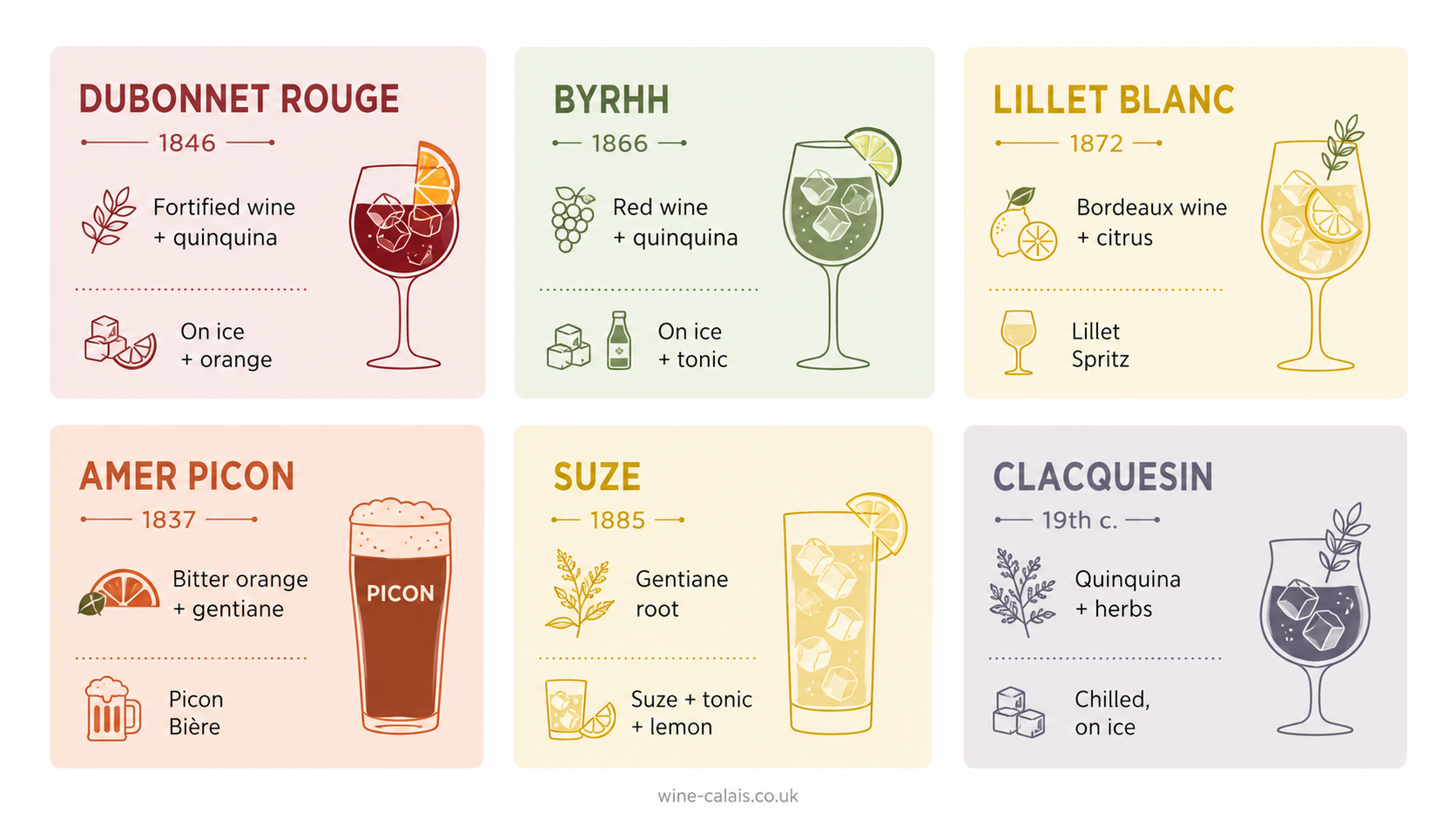
Six classic French aperitifs you can find at Calais Vins
The following six aperitifs share one characteristic beyond their French origin : they are almost impossible to find on a standard British supermarket shelf. Some are rare by nature; others have simply fallen out of UK distribution. All are stocked at Calais Vins and Olivier Vins et Compagnie.
Dubonnet Rouge
Created in 1846 in Paris by Joseph Dubonnet, Dubonnet Rouge is a fortified wine blended with quinquina bark and warm spices. The result is rich and slightly sweet, with a dry bitter finish that prevents it from cloying. Its most celebrated advocate was Queen Elizabeth II, who reportedly enjoyed a daily Dubonnet and gin.
How to serve : chilled over ice with a slice of orange, or in equal parts with gin — the classic Dubonnet Cocktail.
Buy Dubonnet Rouge at Calais Vins →
Byrhh
Founded in 1866 in Roussillon, Byrhh (pronounced "beer" — which causes its own particular confusion when ordering in company) is a red wine base blended with quinquina and tonic herbs. At the turn of the 20th century, it was one of the best-selling drinks in France. Then it nearly vanished entirely. It is back, and worth the rediscovery.
How to serve : chilled over ice with a slice of orange. A splash of tonic water is an option for a longer, lighter drink.
Lillet Blanc
Lillet Blanc was created in 1872 in Podensac, Gironde, by the Lillet brothers. The base is Bordeaux wine, macerated with sweet and bitter orange peel, then aged in oak. ABV : ~17 %. In 1953, Ian Fleming wrote it into his most famous cocktail recipe in Casino Royale :
"Three measures of Gordon's, one of vodka, half a measure of Kina Lillet. Shake it very well until it's ice-cold, then add a large thin slice of lemon peel."
Lillet Blanc now trends across TikTok and cocktail forums as a "gateway aperitif" — one review thread on Reddit described a simple Lillet spritz as "dangerously drinkable." Three expressions are stocked : Blanc, Rosé and Rouge.
How to serve : over ice with an orange or lemon slice, or as a Lillet Spritz (2 parts Lillet Blanc, 3 parts soda or tonic water).
Buy Lillet Blanc at Calais Vins → | Buy Lillet Rosé at Calais Vins → | Buy Lillet Rouge at Calais Vins →
Amer Picon
Amer Picon dates to 1837, when Gaétan Picon created it in Algeria as a quinine-based drink for French soldiers. The base is bitter orange, quinquina and gentiane. Today it is best known as the secret ingredient in Picon Bière : a measure of the liqueur poured into a cold blonde lager, transforming an ordinary glass into something unmistakably French. The combination is most popular in Alsace and northeast France, and almost unknown in the UK.
How to serve : 30 ml Amer Picon poured into a cold lager glass (blonde or pilsner work best).
Buy Amer Picon at Calais Vins →
Suze
Created in 1885, Suze is made not from quinquina but from gentiane root — which gives it a distinctive pale gold colour and an intensely herbal, refreshing bitterness. In the early 20th century it was a staple of French café counters. Today it is a cult favourite among bartenders worldwide, yet its UK retail presence remains minimal. It also forms the base of the Fond de Culotte, a 1930s Parisian bistro classic : Suze, crème de cassis, lemon twist — a drink whose name, according to Rose-Manon Baux of Le Syndicat bar in Paris (10th arrondissement), derives from a wordplay on the original 1930s Suze slogan "l'apéritif qui ne s'use pas" (the aperitif that never wears out).
How to serve : Suze, tonic water and a slice of lemon. Simple and genuinely refreshing.
Clacquesin
Clacquesin is a quinquina-based blend with a herbal profile that puts it among France's rarest surviving classic aperitifs. UK availability : close to zero. Calais Vins stocks it. This is, in practical terms, the most compelling reason to go directly to the source.
How to serve : chilled, over ice.
Buy Clacquesin at Calais Vins →
How to choose and bring back French aperitifs from Calais
Six bottles and no idea where to begin ? The choice is simpler than it looks once you match the aperitif to the drinker.
Matching aperitif to drinker profile
Find your match
Which French aperitif is right for you ?
What do you usually drink before dinner ?
What flavour do you enjoy most ?
How adventurous are you ?
Duty-free saving
Calculate your VAT refund saving
Refund processed via Global Blue (barcode scan at port kiosks) or Skiptax (app) on boarding at Calais.
Quinquina-based aperitifs — Dubonnet Rouge, Byrhh and Lillet Blanc — suit the food-and-wine curious traveller. They carry real heritage, mix well into cocktails and pair cleanly with charcuterie or strong cheese. If your cross-Channel haul already includes a Médoc or a Chablis, these are natural companions.
Gentiane-based bitters — Suze and Clacquesin — are for those who want what bartenders order when they are off duty. Both are largely invisible on UK retail shelves. If you have ever seen a pale gold bottle behind a bar in Paris and been told it was not for sale locally, this is the one to stock up on.
Amer Picon requires no specialist palate : it is simply a beer upgrade. A 30 ml pour into a cold lager takes ten seconds and produces something entirely French. Beer drinkers who have never touched an aperitif shelf are the ideal audience.
UK customs allowances : what counts where
The customs classification of French aperitifs matters for planning your purchase quantities :
| Category | Allowance per person | Aperitifs concerned |
| Fortified / sparkling wine (under 22 % ABV) | 9 litres (~12 × 75cl bottles) | Dubonnet Rouge, Byrhh, Lillet Blanc, Suze, Amer Picon, Clacquesin |
| Spirits (22 % ABV and above) | 4 litres | Strong liqueurs, whisky, gin, rum, etc. |
| Still wine | 18 litres | Separate quota — does not affect aperitif capacity |
Two people travelling together hold a combined 18-litre fortified allowance — approximately 24 × 75cl bottles of aperitif, without declaration. All six aperitifs profiled above fall below 22 % ABV and count toward this allowance, not the spirits quota.
While aperitifs fall under the fortified and sparkling wine allowance, travellers can also benefit from separate wine allowances. Read our complete guide to the UK wine allowance from France to understand how the famous 24-bottle limit can help you maximise your savings.
If you're stocking up for a party or family gathering, don't forget that beer is covered by a separate allowance. Our UK beer allowance guide explains exactly how much beer you can bring back from France and how to make the most of your duty-free trip.
The VAT refund : two routes, one saving
Both Calais Vins and Olivier Vins et Compagnie are partnered with Global Blue and Skiptax for VAT refund processing. The refund rate is ~15 % on all qualifying purchases. Here is how it works :
- Purchase your aperitifs (and any other wines or spirits) at either shop.
- Receive a tax-free voucher at the till, generated by the shop's Global Blue or Skiptax terminal.
- Global Blue : scan the barcode at dedicated kiosks at the Calais port or Eurotunnel terminal before boarding.
- Skiptax : download the Skiptax app and follow the in-app instructions — no kiosk required.
- The refund is processed and returned to your nominated payment method.
"By simply scanning a bar code at the kiosks at the Calais port terminals, the refund process is activated. Or if using Skiptax, you just need to download an app and follow the simple instructions."
Pre-ordering and in-store advice
wine-calais.co.uk lists all 4,000+ references — aperitifs, wines, beers and spirits — for online pre-order. Selections are ready to collect at the relevant shop, removing queue time on the day. Pre-orders of £300 or more include a complimentary cross-Channel ferry crossing.
In-store, both shops operate with English-speaking sommelier teams. At Calais Vins, Jérôme Pont advises personally from the tasting bar :
"All my staff speaks English. We know the tastes of our British customers and are able to advise them according to their desires, and also to propose food and wine pairings."
Olivier Vermisse oversees Olivier Vins et Compagnie at Fréthun, with the same English-language service and the same 4,000-reference catalogue.
Both shops are open daily from 09:00 to 19:00, with Sunday and bank holiday hours of 10:00 to 18:00. Free parking is available in front of both locations.
Calais Vins stocks Lillet Blanc at a price point that, after the ~15 % Global Blue VAT refund, sits materially below standard UK high-street retail for the same bottle. Pre-order at wine-calais.co.uk to confirm availability and collect in store.